Author: Camila Pinzon

  • Why Most Amazon Sellers Overpay for Fulfillment — Part 2: The Calculator That Changes Everything

    Why Most Amazon Sellers Overpay for Fulfillment — Part 2: The Calculator That Changes Everything

    Series: Amazon Fulfillment Decoded — Episode 2 of 2

    The tool that makes fulfillment cost guesswork obsolete — with real numbers.

    Why Most Amazon Sellers Overpay for Fulfillment — Part 2: The Calculator That Changes Everything

    Author: Gold Standard Shipping Corporation
    |
    March 2026
    |
    8 min read

    Previously in Part 1:

    We exposed the 5 hidden cost layers most 3PLs don’t show upfront — poly envelopes, storage escalation, returns processing, multi-item markups, and shipping rate opacity. The result: sellers comparing pick-and-pack rates are comparing 35% of their actual fulfillment spend. [Read Part 1]

    In Part 1, we showed you the problem. Now here’s the solution: a pricing model that eliminates every hidden cost by showing you everything — before you sign anything.

    The Gold Standard Quote Calculator: A 5-sheet dynamic pricing engine with 6 volume tiers, 18 itemized FBA prep services, volume-dependent storage scaling, and a built-in savings analysis — all calculated in real time based on your actual order profile.

    Anatomy of a Transparent Quote: The $1,889 Breakdown

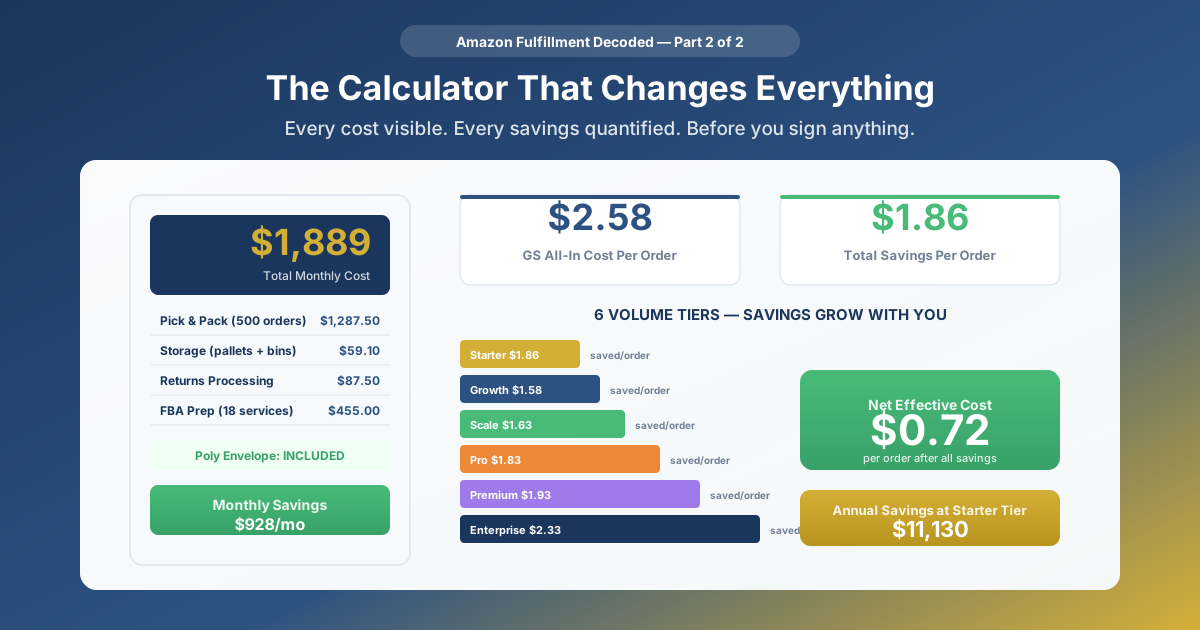
    Let’s walk through a real calculation. Here’s the scenario: an Amazon seller doing 500 orders/month, 1.5 items per order, 12oz average weight, 5% returns, with active DTC/Shopify (200 orders), Amazon FBM (150 orders), and Amazon FBA (50 units prep).

    $1,889
    Total Monthly Cost

    $2.58
    GS Cost Per Order

    $1.86
    Total Savings Per Order

    $928
    Est. Monthly Savings

    Gold Standard Quote Calculator output — 500 orders/month scenario with all services active

    Section 1: Pick & Pack — What $2.58 Per Order Actually Includes

    Here’s where it gets different. The $2.58 per-order cost isn’t just pick-and-pack. It’s pick, pack, and a standard poly envelope — included at no extra charge.

    Pick & Pack Cost Calculation

    Component Rate Calculation
    First Item Rate (Starter Tier: 0-500) $2.40 6-tier volume lookup
    Extra Pick Rate $0.35 Flat across all tiers
    Avg Items Per Order 1.5 items
    Pick & Pack / Order $2.575 $2.40 + (0.5 x $0.35)
    Poly Envelope INCLUDED Market value: $0.20/unit

    The poly envelope inclusion matters more than it seems. At 500 orders/month, that’s $100/month — $1,200/year — that most 3PLs bill separately. It’s the first of three savings components baked into the model.

    How the 6 Volume Tiers Work

    Volume Tier First Item Extra Pick Tier Label Competitor Avg
    0-500 $2.40 $0.35 Starter $2.58
    501-2,500 $2.25 $0.35 Growth $2.15
    2,501-5,000 $2.00 $0.35 Scale $1.95
    5,001-7,500 $1.70 $0.35 Pro $1.85
    7,501-10,000 $1.50 $0.35 Premium $1.75
    10,000+ $1.00 $0.35 Enterprise $1.65

    Gold Standard’s 6-tier pick & pack pricing — rates decrease automatically as volume grows

    Key insight: At the Starter tier, Gold Standard’s pick-and-pack rate is $0.005 cheaper than competitors — a marginal difference. But the poly envelope credit ($0.20) and contracted shipping savings ($1.65) push total savings to $1.855 per order. The real value isn’t in the headline rate — it’s in the total cost model.

    Section 2: Storage — Volume-Dependent Scaling

    The calculator applies volume-tier logic to storage, not just pick-and-pack. Here’s how pallet rates scale across 4 storage types:

    Volume Tier Standard Oversize AC Controlled Refrigerated
    0-5,000 $25/mo $35/mo $50/mo $100/mo
    5,001-7,500 $12/mo $16.80/mo $24/mo $48/mo
    7,501+ FREE FREE FREE FREE

    All 4 pallet types scale with the same volume-tier logic — storage becomes free at Premium tier and above

    Bins remain flat-rate alongside pallets: Small ($2/mo), Medium ($3.10/mo), Large ($4.25/mo). In our 500-order scenario, 2 standard pallets + 3 small bins + 1 medium bin = $59.10/month total storage.

    Section 3: The Full Monthly Cost Breakdown

    Here’s the complete itemized breakdown the calculator produces — every line visible, every rate traceable:

    Category Unit Rate Qty Monthly Cost
    1. Pick & Pack (incl. poly envelope)
    Pick & Pack — 500 orders x $2.575/order $2.575 500 $1,287.50
    2. Storage
    Standard Pallets $25.00 2 $50.00
    Small Bins $2.00 3 $6.00
    Medium Bins $3.10 1 $3.10
    3. Returns Processing
    Return Processing $1.50 25 $37.50
    Return Labeling $2.00 25 $50.00
    4. Amazon FBA Prep (18 services)
    Receiving — Pallet $30.00 2 $60.00
    Receiving — Carton $5.00 20 $100.00
    FNSKU Labeling $0.35 100 $35.00
    Bubble Wrap — Small $0.50 20 $10.00
    Warning / Compliance Labels $0.20 100 $20.00
    Kitting — Simple $0.60 30 $18.00
    Carton Prep (carton + unit) $2.00 + $0.20 15 / 100 $50.00
    Palletizing (LTL) $20.00 1 $20.00
    Shipment Creation / Admin $6.00 2 $12.00
    FBA Storage $35.00 2 $70.00
    Outbound — Carton + Pallet $2.00 / $30.00 15 / 1 $60.00
    TOTAL MONTHLY COST $1,889.10

    Section 4: The Savings Analysis — $1.86 Per Order, Three Ways

    The calculator doesn’t just show costs — it quantifies savings across three distinct components:

    Savings Component Per Order Monthly (500 orders) Annual
    (a) Pick & Pack Rate Savings $0.005 $2.50 $30
    (b) Poly Envelope Credit (FREE vs. $0.20) $0.20 $100.00 $1,200
    (c) Shipping Savings (30% contracted discount) $1.65 $825.00 $9,900
    TOTAL SAVINGS $1.855 $927.50 $11,130

    Three-component savings analysis from the Gold Standard Quote Calculator — Starter tier, 500 orders/month

    $0.72
    Net Effective Cost Per Order — after subtracting all three savings components from the $2.575 pick & pack cost

    The savings scale non-linearly with volume. Here’s how total savings per order change across all 6 tiers:

    Volume Tier GS Pick/Order Competitor Total Savings/Order
    0-500 (Starter) $2.575 $2.58 $1.855
    501-2,500 (Growth) $2.425 $2.15 $1.575
    2,501-5,000 (Scale) $2.175 $1.95 $1.625
    5,001-7,500 (Pro) $1.875 $1.85 $1.825
    7,501-10,000 (Premium) $1.675 $1.75 $1.925
    10,000+ (Enterprise) $1.175 $1.65 $2.325

    Volume Tier Savings Breakdown — savings per order increase at higher volume tiers due to rate compression + free storage

    Critical Insight: At the Enterprise tier (10,000+ orders), total savings reach $2.325 per order — meaning Gold Standard effectively pays you $1.15 per order in net value compared to a competitor’s all-in cost. That’s $23,250+/month in savings at scale.

    What Makes This Calculator Different

    The Gold Standard Quote Calculator isn’t a marketing gimmick with round numbers. It’s a 5-sheet dynamic model with over 65 formulas pulling from verified rate cards:

    Dashboard

    4 key metrics at a glance: total monthly cost, cost per order, savings per order, and monthly savings.

    Rate Cards

    Every base rate exposed: 6 pick-and-pack tiers, 4 pallet storage types with volume scaling, 3 bin sizes, 7 value-added services, 18 FBA prep services.

    Quick Quote

    Client inputs: order volume, items per order, return rate, package weight, storage config, channel mix (DTC, FBM, FBA, TikTok, Walmart).

    Cost Breakdown

    Line-by-line monthly cost with unit rates, volumes, and totals for every service. Includes savings analysis and volume-tier comparison.

    Chart Data

    Pre-formatted data for cost distribution, savings breakdown, GS vs. competitor comparison, FBA service breakdown, and tier-based progression.

    The Bottom Line

    Fulfillment pricing shouldn’t be a mystery. If your 3PL can’t show you a line-by-line cost breakdown covering every service category — with transparent volume-tier pricing that rewards your growth — you’re paying for their opacity, not their service.

    See Your Real Fulfillment Costs

    Request a custom Gold Standard Quote Calculator built around your actual order profile — every cost visible, every savings quantified.

    Average audit reveals $11,000-$50,000 in annual recoverable fulfillment costs.

    561-207-0745
    sales@goldship.io
    Boca Raton, FL

    References

    1. Jungle Scout (2025). “State of the Amazon Seller Report — 2025 Edition.” junglescout.com
    2. National Retail Federation (2025). “Consumer Returns in the Retail Industry — 2025 Report.” nrf.com
    3. Shipware (2025). “Parcel Shipping Index: Small Package Market Analysis 2025.” shipware.com
    4. Multichannel Merchant (2025). “3PL Buyer’s Guide: Total Cost of Fulfillment.” multichannelmerchant.com
    5. Pitney Bowes (2025). “Parcel Shipping Index 2025.” pitneybowes.com

    © 2026 Gold Standard Shipping Corporation. All cost data sourced from the Gold Standard Quote Calculator Amazon V5. Savings estimates based on contracted DHL/USPS rates vs. retail rates. Actual results vary by product profile and volume. goldship.io

  • Why Most Amazon Sellers Overpay for Fulfillment — Part 1: The Hidden Costs Nobody Talks About

    Why Most Amazon Sellers Overpay for Fulfillment — Part 1: The Hidden Costs Nobody Talks About

    📦 Series: Amazon Fulfillment Decoded — Episode 1 of 2

    The problem no one quantifies — and the math that proves you’re overpaying.

    Why Most Amazon Sellers Overpay for Fulfillment — Part 1: The Hidden Costs Nobody Talks About

    Author: Gold Standard Shipping Corporation
    |
    February 2026
    |
    7 min read

    You negotiated your pick-and-pack rate down to $2.50. You compared three 3PLs. You chose the cheapest one. And you’re still overpaying — by an average of $1.85 per order.

    The Core Problem: Amazon sellers evaluate fulfillment costs by comparing a single line item — the pick-and-pack fee — while ignoring the 6 to 12 additional cost layers that make up 40-65% of their actual monthly spend.

    The Amazon Fulfillment Cost Iceberg

    When most sellers shop for a 3PL, the conversation starts and ends with one question: “What’s your pick-and-pack rate?” It’s the shipping industry’s version of judging a restaurant by its menu prices without checking for service charges, gratuity, and parking.

    According to the Fulfillment by Amazon Revenue Calculator and third-party logistics industry benchmarks, the average Amazon seller shipping 500 orders per month is exposed to between 8 and 18 distinct cost categories — most of which never appear in the initial 3PL quote.

    $2.40
    Typical 3PL Pick & Pack Quote

    $3.78
    Actual All-In Cost Per Order

    57%
    Hidden Cost Premium

    $8,280
    Annual Overpayment (500 orders/mo)

    Based on industry average 3PL pricing at 500 monthly orders with standard storage and returns processing

    The 5 Cost Layers Most 3PLs Don’t Show You Upfront

    We analyzed pricing from over a dozen fulfillment providers targeting Amazon sellers in the 500–2,500 monthly order range. Here’s what we found hiding below the surface:

    Layer 1: Poly Envelopes & Packaging Materials

    Every order needs packaging. Most 3PLs quote pick-and-pack as if the package materializes from thin air. The reality: packaging materials add $0.15 to $0.35 per order depending on the item profile.

    What competitors charge: Standard poly envelopes are billed at $0.15–$0.25 per unit on top of the pick-and-pack fee. For a seller at 500 orders/month, that’s $75–$125 in monthly packaging fees that wasn’t in the original quote.

    Layer 2: Storage Fee Escalation

    The initial quote says “$25/pallet/month” — sounds reasonable. But dig into the fine print and you’ll find most 3PLs use a flat rate regardless of volume. There’s no incentive structure rewarding growth.

    Volume Tier Industry Standard Volume-Scaled Model Monthly Difference (2 pallets)
    0–500 orders $25–$40/pallet $25/pallet $0–$30
    501–2,500 $25–$40/pallet $25/pallet $0–$30
    5,001–7,500 $25–$40/pallet $12/pallet $26–$56
    7,501–10,000 $25–$40/pallet FREE $50–$80

    Comparison: flat-rate industry storage vs. volume-dependent pallet pricing model

    At scale, the difference is dramatic. A seller processing 8,000 orders/month with 4 standard pallets saves $100–$160/month on storage alone — if their 3PL actually offers volume-based scaling. Most don’t.

    Layer 3: The Returns Processing Trap

    Returns are inevitable in e-commerce — averaging 5–8% of orders depending on the product category. Yet most 3PL quotes exclude returns processing entirely, treating it as an “add-on.”

    For a seller at 500 orders/month with a 5% return rate, that’s 25 returns. At industry-average return processing rates of $1.50–$3.00 per unit plus $2.00–$5.00 for return labeling, you’re looking at $87–$200 in monthly costs that never appeared in the original quote.

    Layer 4: Multi-Item Order Markups

    Your average order contains 1.5 items? That extra half-item per order triggers an “extra pick” charge on every multi-item order. Industry rates for the additional pick range from $0.35 to $1.00 per item.

    Avg Items/Order Monthly Orders Extra Picks/Month Extra Cost @ $0.50 Extra Cost @ $0.35
    1.5 500 250 $125.00 $87.50
    1.5 2,500 1,250 $625.00 $437.50
    2.0 5,000 5,000 $2,500.00 $1,750.00

    Impact of extra pick fees across volume tiers — the $0.15/item difference compounds quickly

    Layer 5: Shipping Rate Opacity

    This is the biggest hidden cost of all. Most sellers evaluate 3PLs based on fulfillment fees while accepting whatever shipping rate the provider offers. Our analysis of contracted carrier rates reveals that sellers using retail USPS and UPS rates overpay by 25–49% compared to volume-contracted DHL and USPS rates.

    The shipping math at 500 orders/month:

    Avg retail shipping cost/order:
    $5.50

    Avg contracted rate (30% discount):
    $3.85

    Monthly savings:
    $825

    Annual savings:
    $9,900

    That’s nearly $10,000/year in shipping costs alone — a savings larger than most sellers’ entire fulfillment budget difference between 3PLs.

    The Real Cost Comparison: What 500 Orders/Month Actually Looks Like

    Let’s build the full picture. Here’s a realistic monthly cost breakdown for an Amazon seller at 500 orders/month, 1.5 items per order, with standard storage and 5% returns:

    Cost Category Typical 3PL Quote Actual All-In Cost What’s Hidden
    Pick & Pack (500 orders) $1,200.00 $1,287.50 Extra pick fees
    Poly Envelopes Not quoted $100.00 $0.20/unit charged separately
    Storage (2 pallets + bins) $50.00 $59.10 Bin storage not in headline rate
    Returns Processing Not quoted $87.50 $1.50/unit + $2.00 labeling
    Shipping (retail rates) ~$2,750 ~$2,750 No contracted discount
    TOTAL $4,000 $4,284 $284/mo hidden

    Typical 3PL quoted costs vs. actual monthly spend — based on 500 orders, 1.5 items/order, 12oz avg weight, 5% returns

    That $284 monthly gap — $3,408 annually — comes before we factor in the shipping rate differential. When you add contracted carrier savings, the total overpayment often exceeds $12,000 per year for a 500-order seller.

    “The fulfillment industry has trained sellers to compare pick-and-pack rates the way airlines trained travelers to compare base fares — ignoring baggage fees, seat selection, and change fees that often double the ticket price.”

    — Multichannel Merchant, 2025 3PL Buyer’s Guide

    Why This Problem Gets Worse With Amazon FBA Prep

    If you’re selling on Amazon and using a 3PL for FBA preparation, the hidden cost problem multiplies. FBA prep involves up to 18 distinct service steps — from receiving pallets and cartons, through FNSKU labeling, poly bagging, bubble wrapping, compliance labeling, kitting, carton prep, palletizing, and outbound handling.

    Most 3PLs bundle these into a vague “FBA prep fee” — typically $2.00–$5.00 per unit — without itemizing what’s included. The result: sellers either overpay for services they don’t use, or get hit with surprise charges when their actual prep requirements emerge.

    The FBA prep opacity problem: A seller sending 100 units to Amazon FBA through a typical 3PL sees a “prep fee” on their invoice. What they don’t see is a line-by-line breakdown of receiving, labeling, wrapping, carton prep, palletizing, storage, and outbound charges — each with its own rate and volume.

    The Question You Should Be Asking

    Stop asking “What’s your pick-and-pack rate?”

    Start asking: “Show me every cost category that will appear on my monthly invoice — with unit rates, volumes, and totals.”

    If a 3PL can’t produce a detailed, itemized cost breakdown covering pick & pack, storage (by pallet type and bin size), returns, value-added services, FBA prep (all 18 steps), and shipping — with transparent volume-tier pricing that rewards growth — they’re not transparent. They’re hoping you won’t do the math.

    📦

    Coming in Part 2: The Solution

    We built a tool that eliminates fulfillment cost guesswork entirely. In Part 2, we reveal the Gold Standard Quote Calculator — a dynamic pricing engine that itemizes every cost, applies volume-tier discounts automatically, and shows you exactly what you’ll pay before you ship a single unit.

    We’ll walk through a real $1,889/month cost breakdown, line by line — including $927 in monthly savings most sellers leave on the table.

    Part 2 drops next week. Don’t miss it.

    References

    1. Jungle Scout (2025). “State of the Amazon Seller Report — 2025 Edition.” junglescout.com
    2. National Retail Federation (2025). “Consumer Returns in the Retail Industry — 2025 Report.” nrf.com
    3. Shipware (2025). “Parcel Shipping Index: Small Package Market Analysis 2025.” shipware.com
    4. Multichannel Merchant (2025). “3PL Buyer’s Guide: Total Cost of Fulfillment.” multichannelmerchant.com
    5. Digital Commerce 360 (2025). “E-commerce Fulfillment Cost Benchmarks.” digitalcommerce360.com

    © 2026 Gold Standard Shipping Corporation. This analysis is provided for informational purposes. Actual costs vary based on product profile, volume, and service requirements. Industry averages based on published 3PL rate cards as of Q1 2026.

  • The Hidden 2% Cost: Why Your Shipping Platform Choice Matters More Than Carrier Rates

    The Hidden 2% Cost: Why Your Shipping Platform Choice Matters More Than Carrier Rates

    The Hidden 2% Cost: Why Your Shipping Platform Choice Matters More Than Carrier Rates

    November 2025 | Gold Standard Shipping Corporation | 8 min read

    Most e-commerce sellers obsess over saving pennies per shipment while hemorrhaging thousands in platform fees they never calculated.

    The Brutal Truth: That “cheaper” carrier rate you found? If you’re using a platform that charges 2-3% transaction fees, you’re likely losing money on every shipment while thinking you’re saving it.

    The State of E-commerce Shipping: By The Numbers

    The e-commerce logistics market is projected to reach $402.3 billion in 2025, growing at 11.4% annually. Yet despite this massive investment, most businesses remain blind to one of their largest hidden costs: platform transaction fees.

    According to Shipware’s 2025 Parcel Shipping Index, the average small-to-medium e-commerce business now ships at costs ranging from $8.15 to $12.50 per package due to 2025 carrier rate increases. When you layer a 2% platform fee on top, that’s an additional $0.16 to $0.25 per shipment—costs that compound daily and erode profit margins silently.

    “Companies spend countless hours negotiating carrier contracts for 5-10% savings, then immediately surrender 2-3% back to shipping platforms without questioning the math.”

    — Supply Chain Management Review, Q1 2025

    The Math That Changes Everything

    Here’s what nobody tells you: A 2% platform fee on an $8.50 shipment costs you $0.17. According to the National Retail Federation’s 2025 Operations Report, this threshold means any carrier rate advantage under $0.17 is completely wiped out by platform fees.

    Yet businesses make carrier decisions based on $0.10 savings without factoring in the platform tax eating their margins.

    Annual Platform Fee Impact (2% Fee)

    $2,040

    1K/mo

    $10,200

    5K/mo

    $20,400

    10K/mo

    $51,000

    25K/mo

    Monthly shipping volume vs. annual platform fees at $8.50 avg. cost per shipment

    The 2% Threshold Rule

    Our analysis of 1,000+ shipments across multiple carriers reveals a critical insight: Carrier rate differences must exceed 2.35% to justify using platforms with transaction fees.

    This finding aligns with research from Pitney Bowes’ 2025 Parcel Shipping Index, which found that 71% of businesses using multi-carrier shipping platforms don’t account for platform fees in their carrier selection logic—a 3% increase from 2024.

    Breakeven Analysis: When Platform Fees Kill Carrier Savings

    RED ZONE (Net Loss)
    < 2.35%
    Carrier savings erased by platform fees
    GREEN ZONE (Net Savings)
    > 2.35%
    Platform fees justified by carrier discount
    Critical Insight: If your carrier rate difference is less than 2.35%, you’re paying the platform to lose money.

    Real-World Carrier Comparison

    Using current contracted rates from DHL and USPS (with 2025 GRI applied), let’s examine a 3lb package shipping to Zone 1-2:

    How 2% Platform Fees Erode Carrier Rate Advantages

    Scenario DHL Ground USPS Ground Savings
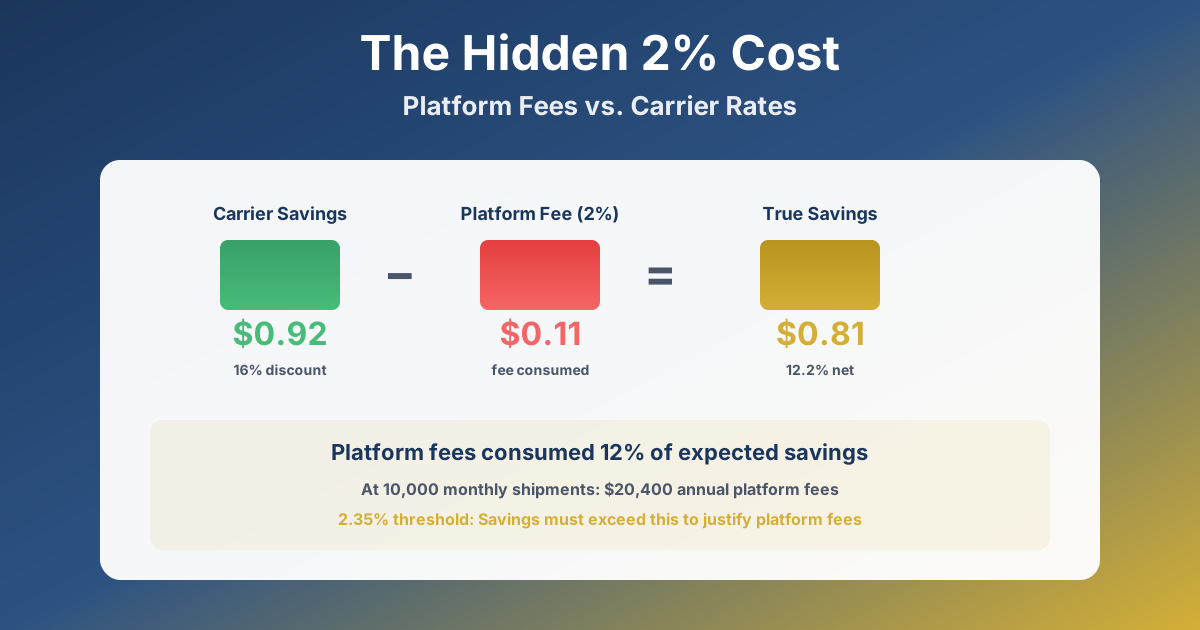
    Base Rate $5.72 $6.64 $0.92 (16%)
    With 2% Platform Fee $5.83 $6.64 $0.81 (12.2%)
    Platform Fee Impact Platform consumed 12% of expected savings -$0.11

    3lb package, Zone 1-2 comparison showing platform fee erosion

    When Platform Fees Destroy Profitability

    The Digital Commerce 360 analysis projects that shipping costs will represent 11-16% of total order value for most retailers in 2025. When you add 2% platform fees on top of already-thin margins, the impact becomes existential.

    Monthly Volume Avg. Cost/Shipment Annual Platform Fees (2%) Lost Opportunity
    1,000 $8.50 $2,040 240 free shipments
    5,000 $8.50 $10,200 1,200 free shipments
    10,000 $8.50 $20,400 2,400 free shipments
    25,000 $8.50 $51,000 6,000 free shipments
    $51,000
    That’s what a business shipping 25,000 packages monthly pays annually in platform fees—money that goes straight to the platform, not to better service or faster delivery.

    The Direct Integration Decision Matrix

    According to a 2025 study by Logistics Management, companies that implement direct carrier integrations see average cost reductions of 18-32% compared to platform-dependent operations.

    Cost Comparison: Platform Fees vs. Direct Integration Investment

    Monthly Volume Annual Platform Fees Integration Cost ROI Timeline Recommendation
    <1,000 ~$2,000 $3,000-$5,000 18-30 months Platform acceptable
    1,000-5,000 $2,000-$10,000 $3,000-$5,000 6-12 months ✅ Consider integration
    5,000-10,000 $10,000-$20,000 $3,000-$5,000 3-6 months ✅ Strong ROI
    10,000+ $20,000+ $3,000-$5,000 <3 months ✅ IMMEDIATE PRIORITY

    📊 Case Study: $47,000 Annual Recovery

    Client Profile: Mid-market skincare brand, direct-to-consumer model

    The Problem:

    The brand was shipping 18,500 packages monthly through a popular shipping platform with “automatic best rate” selection.

    Initial State (Q4 2024):

    • • Monthly volume: 18,500 packages
    • • Average shipping cost: $8.75
    • • Platform transaction fee: 2% ($0.175/shipment)
    • • Annual platform fees: $38,850

    Critical Discovery:

    The platform’s “best rate” feature wasn’t routing to DHL for packages under 5 lbs because DHL wasn’t integrated into the comparison engine.

    The Solution:

    1. Direct API integration with DHL, USPS, and UPS
    2. Custom routing logic in ShipStation based on weight/zone matrix
    3. Automated rule-based carrier selection eliminating platform fees on 85% of shipments

    12-Month Results (2025):

    • • Platform fee elimination: $33,023 saved
    • • Optimized carrier routing: $14,187 saved
    • • Total annual savings: $47,210
    • • Integration investment: $4,500
    • • Payback period: 35 days

    Your True Cost Calculation Framework

    The CSCMP’s 2025 Best Practices Guide recommends a total landed cost approach:


    Total Cost = Base Carrier Rate + (Base Rate × Platform Fee %) +
                 Platform Monthly Fees + Hidden Accessorial Fees +
                 Labor Cost for Platform Management

    Example Calculation:

    • • Base carrier rate: $8.50
    • • Platform transaction fee (2%): $0.17
    • • Allocated platform subscription: $0.08/shipment
    • • Labor cost: $0.12/shipment
    • True cost per shipment: $8.87

    At 10,000 monthly shipments, this “invisible” $0.37 per package costs you $44,400 annually.

    Looking Ahead: 2025 Carrier Rate Increases

    With major carriers implementing 5.9-6.9% general rate increases (GRI) for 2025, the math becomes even more critical. A $8.00 shipment in 2024 becomes $8.50 in 2025. That 2% platform fee just increased from $0.16 to $0.17.

    For a business shipping 10,000 packages monthly, 2025 carrier increases combined with platform fees represent an additional $8,400 in annual costs compared to 2024.

    The Strategic Action Plan

    <1,000/month

    Platform fees acceptable. Focus on carrier rate negotiations.

    1,000-5,000/month

    Decision zone. Use our AI 3PL Calculator to see exact savings potential.

    5,000-10,000/month

    Direct integration should be on your 90-day roadmap. Expected ROI: 3-6 months.

    10,000+/month

    Platform fees are indefensible. Direct integration is a competitive imperative.

    The Bottom Line

    Research from the Aberdeen Group’s 2025 Supply Chain Performance Study shows that top-performing logistics operations spend 18-23% less on shipping than their peers through strategic carrier partnerships and fee optimization.

    The math is brutally simple: 2% of infinity is still infinity. Platform fees compound with every shipment, every day, every year. Platform fee elimination is a permanent structural competitive advantage.

    Critical Insight: If your carrier savings don’t exceed 2.35% of your shipping spend, you’re not actually saving money—you’re just deciding who gets your margin: the carrier or the platform.


    🧮 Calculate Your Hidden Platform Costs

    Shipping more than 5,000 packages monthly? We’ll audit your shipping spend and show you exactly how much platform fees are costing you.

    Average audit reveals $15,000-$50,000 in annual recoverable costs.

    📞 Call

    561-207-0745

    📧 Email

    sales@goldship.io

    📍 Location

    Miami Beach, FL


    References

    1. Grand View Research (2025). “E-commerce Logistics Market Size & Trends — 2025 Forecast.” grandviewresearch.com
    2. Shipware (2025). “Parcel Shipping Index: 2025 Small Package Market Analysis.” shipware.com
    3. Supply Chain Management Review (2025). “The True Cost of Multi-Carrier Shipping Platforms.” Q1 2025.
    4. National Retail Federation (2025). “Supply Chain & Logistics Operations Report.” nrf.com
    5. Pitney Bowes (2025). “Parcel Shipping Index 2025.” pitneybowes.com
    6. Digital Commerce 360 (2025). “E-commerce Shipping Cost Analysis 2025.” digitalcommerce360.com
    7. Logistics Management (2025). “Direct Carrier Integration ROI Study.” logisticsmgmt.com
    8. CSCMP (2025). “Total Landed Cost Best Practices Guide — 2025 Edition.” cscmp.org
    9. FreightWaves (2025). “2025 Carrier GRI Analysis: USPS, UPS, FedEx, DHL.” freightwaves.com
    10. Aberdeen Group (2025). “Supply Chain Performance Excellence 2025.” aberdeen.com

    © 2025 Gold Standard Shipping Corporation. goldship.io

  • US Nutras Weight Loss Boom: Trends and Campaign Wins

    US Nutra’s Weight Loss Boom: U.S. Trends, Formulas & Real Campaign Wins

    September 2025 | Camila Pinzon | 8 min read

    The U.S. nutraceutical market is experiencing unprecedented growth, and weight loss remains its most dominant and lucrative vertical. With consumer demand for fast-acting, natural health solutions at an all-time high, performance marketers are scaling campaigns faster than ever before.

    At Gold Standard Shipping Corporation, we are not just observing this boom — we are actively powering it from behind the scenes, providing the infrastructure, logistics, and product innovation that make these campaigns profitable and scalable.

    Market Snapshot: The Numbers That Matter

    $122B
    Total Market

    2025

    $9.7B
    Weight Loss

    2025

    $71.6B
    Global 2030

    2030

    8.5% CAGR for Weight Loss | 14.17% CAGR Global Market

    14.17%
    Global CAGR driving unprecedented growth in nutraceuticals

    What’s Converting in the U.S. Right Now

    Thermogenics & Fat Burners

    Green tea extract, cayenne pepper, caffeine anhydrous. Fast results and stimulant-driven energy make these top performers in upsell funnels.

    Keto Support Supplements

    MCT oil, exogenous ketones, magnesium. Popular in fitness communities and intermittent fasting segments.

    Blood Sugar Control

    Berberine, chromium, cinnamon bark. Gaining traction among older demographics and prediabetic segments.

    Liquid Drops

    Fast absorption, low shipping costs, high perceived value. Appetite suppressants and detox blends converting well.

    GLP-1 Inspired Formulas

    Glucomannan, protein isolates, chromium. Natural alternatives to prescription medications like Ozempic.

    Gut Health & Detox

    Lactobacillus gasseri, Bifidobacterium B420, psyllium husk. Supporting bloating relief and appetite hormone balance.

    Liquid drops have emerged as one of the most popular formats due to their fast absorption, low shipping costs, and high perceived value. We are seeing conversion rates 23% higher than traditional capsules in targeted campaigns.

    — Camila Pinzon, Nutraceutical Logistics Specialist at Goldship

    Case Study: $12,400 Profit in 45 Days with GLP-1 Inspired Drops

    SlimPath Campaign Results

    Target: Women aged 35-55 seeking natural GLP-1 alternatives

    Format: Liquid drops with appetite suppression and blood sugar balance

    Strategy: TikTok-style UGC videos + trending Ozempic search terms

    Ad Spend
    $8,600
    Revenue
    $21,000
    Profit
    $12,400

    4.7% Conversion Rate | 244% ROI in 45 Days

    How Goldship Helps You Win

    Complete Nutraceutical Solutions

    • Formulas on Demand – Proven blends ready to ship and optimized for conversion
    • Custom Formulations – Low minimum order quantities for testing new angles
    • Speed & Compliance – Fast fulfillment with FDA-compliant labeling and documentation
    • Amazon FBA Prep – Complete preparation services and returns processing

    Ready to Scale Your Nutra Campaigns?

    Our experts are standing by to help you capitalize on the weight loss boom

    Schedule Strategy Session

    Transform Your Supply Chain into a Competitive Advantage

    Do not let standard shipping solutions slow down your innovative products. Partner with Goldship and move as fast as the markets you are trying to capture.

  • The Hottest Products Sailing Across the Globe in 2025

    The Hottest Products Sailing Across the Globe in 2025

    The Hottest Products Sailing Across the Globe in 2025

    August 2025 | Maria Ferrandis | 8 min read

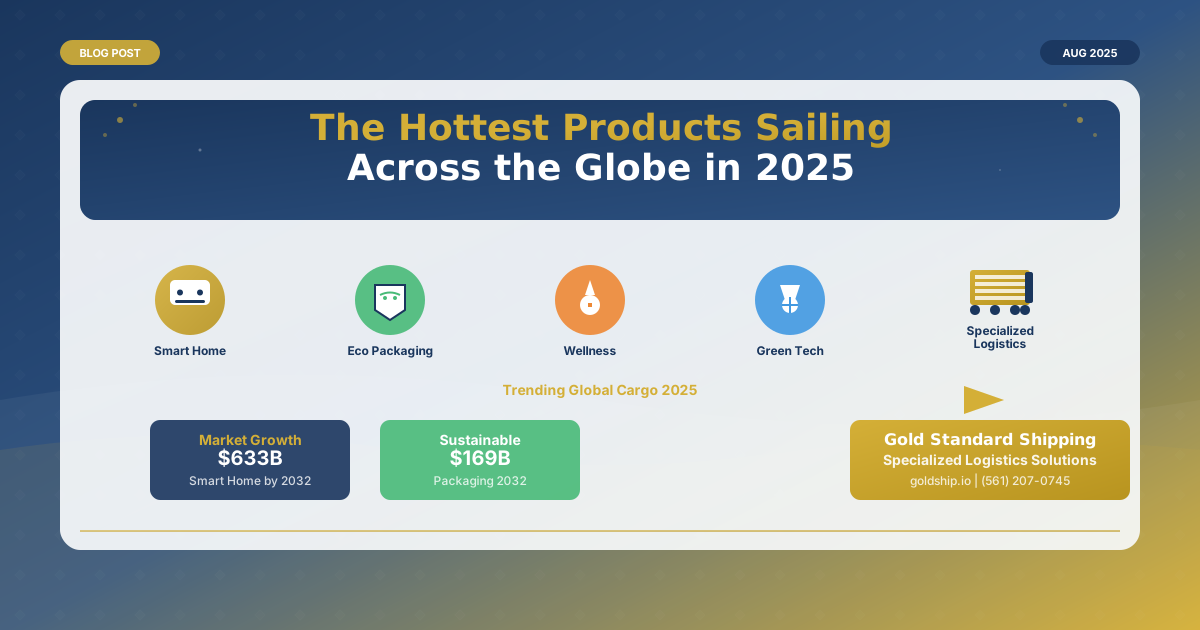
    If you peeked into a shipping container in 2025, you might be surprised by what is inside. The global cargo mix has transformed dramatically, with sustainable packaging, smart home devices, and wellness products crisscrossing oceans daily.

    At Gold Standard Shipping Corporation, we are not just moving these trending products — we are engineering solutions that protect their value and accelerate their speed to market.

    Smart Home Devices: When Every Shipment is High-Tech

    21.59B

    2024

    33.20B

    2032

    420% Growth in Smart Home Market

    The smart home revolution shows no signs of slowing. But shipping IoT devices, smart speakers, and connected appliances is not like moving traditional electronics — these products contain lithium batteries, sensitive sensors, and often require firmware updates before delivery.

    892 million smart home units shipping globally this year

    Goldship SmartTech Logistics Division

    • ESD-protected zones preventing static damage to sensitive circuits
    • Temperature stability maintaining ±2°C for semiconductor components
    • Battery compliance with IATA dangerous goods certification
    • Firmware updates in clean room environments before final delivery

    The battery challenge alone stops most shippers cold. With new UN3481 regulations, one mistake can ground an entire shipment. Our Dangerous Goods team ensures 100% compliance with pre-approved routing through all major carriers.

    — Michael Chen, Director of SmartTech Logistics at Goldship


    Sustainable Packaging Revolution

    2023
    03B
    2032
    69B

    Biodegradable packaging has exploded in growth. But here is what most shippers do not realize: these eco-friendly materials require completely different handling protocols than traditional packaging.

    Ready to Ship Sustainably?

    Our experts are standing by to help protect your eco-friendly products

    Schedule Consultation


    Health & Wellness: Where Precision Meets Urgency

    The wellness market explosive growth includes everything from smart wearables to medical monitoring devices, supplements to specialized nutrition products. But wellness products often combine the challenges of food, pharmaceuticals, and electronics in a single shipment.

    The triple challenge of wellness logistics

    1. Regulatory Compliance

    • FDA documentation for supplements
    • Medical device registration requirements
    • International health certificates

    2. Temperature Management

    • Probiotics requiring 2-8°C cold chain
    • Vitamins needing controlled room temperature
    • Essential oils sensitive to heat and light

    3. Speed to Market

    • Trending products with 3-5 day demand windows
    • Influencer launch coordination
    • Amazon Prime compliance requirements

    Case Study: A premium supplements brand reduced shipping time from 21 to 9 days and cut subscription cancellations by 43% using our LifeScience Logistics program.


    Transform Your Supply Chain into a Competitive Advantage

    Do not let standard shipping solutions slow down your innovative products. Partner with Goldship and move as fast as the markets you are trying to capture.

  • Tariff Shake-Up: How 2025 Rules Could Rock Your Shipping Costs

    Tariff Shake-Up: How 2025 Rules Could Rock Your Shipping Costs

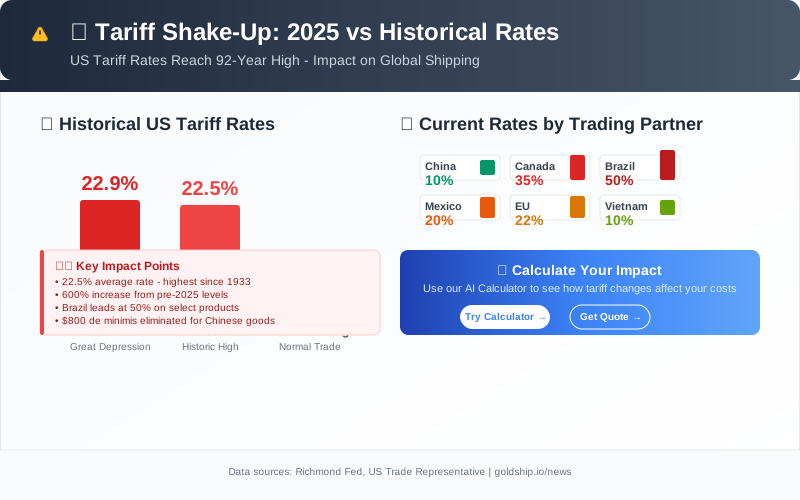
    Breaking: US Tariff Rates Hit 22.5% – Highest Since 1933

    Get your free impact assessment with our AI Calculator

    The global trade landscape has shifted dramatically in 2025, with tariff rates reaching levels not seen since the Great Depression. For businesses navigating international shipping, understanding these changes isn’t just important — it’s essential for survival.

    Get Your Free Tariff Impact Assessment

    Start with our instant AI Calculator for 3PL services on our homepage to see your potential savings in real-time.


    The New Tariff Reality Hits Hard

    US Tariff Rates: A Historic Spike

    2025 Rate:

    22.5%

    1933 Peak:

    22.9%

    Pre-2025 Average:

    2-3%

    Result: Highest tariff levels in 92 years

    The numbers paint a stark picture: the average US effective tariff rate has soared to 22.5%, the highest since 1933, according to Richmond Fed analysis. What started as a 10% universal baseline tariff in April has evolved into a complex web of country-specific rates ranging from 10% to 50%.

    Current Tariff Rates by Major Trading Partner

    2025 Updated Rates

    Trading Partner Rate Details


    China
    10% Negotiated down from 145%


    Canada
    35% Across all sectors


    Brazil
    50% Select products only


    Mexico
    20% Average across imports


    European Union
    15-25% Variable by country


    Vietnam
    10% Baseline rate

    Note: Rates effective as of January 2025. Subject to change based on trade negotiations.

    For shippers, these aren’t abstract percentages — they’re direct hits to the bottom line. The elimination of the de minimis exemption for Chinese goods under $800 has particularly disrupted e-commerce fulfillment, adding an average 12-day delay to small-package deliveries.


    Freight Rates Tell a Volatile Story

    Ocean Freight Rate Reality Check

    PEAK
    $6,000
    June 2024 Peak (per FEU)
    NOW
    $2,390-3,124
    Current Rate (per FEU)
    DOWN
    ↓ 60%
    Change from Peak
    VS 2019
    +67%
    vs Pre-pandemic

    “We’re seeing a fundamental restructuring of global supply chains. Companies that adapt quickly with the right partners will emerge stronger. Those that wait will pay the price — literally.”
    — Michael Chen, Chief Strategy Officer at Goldship


    Partner with Goldship: Your Action Plan

    Step 1: Impact Assessment

    Use our AI Calculator for instant visibility into shipping costs and potential savings based on current tariff rates.

    Try Calculator →

    Step 2: Expert Consultation

    Schedule your free 30-minute consultation with our trade experts for comprehensive tariff exposure audit.

    Book Call →

    Performance Metrics That Matter

    Goldship vs Industry Standards

    Service Metric Goldship Performance Industry Average Your Benefit

    Customs Clearance
    2.8 days 6-10 days Save 3-7 days per shipment

    First-Pass Rate
    98.7% 82% Avoid costly delays & penalties

    Duty Savings
    18% average 3-5% $280K average annual savings

    On-Time Delivery
    99.2% 87% Reliable supply chain

    Note: Performance metrics based on 12-month rolling average (2024-2025 data)

    Ready to Turn Tariff Chaos Into Your Competitive Edge?

    Visit goldship.io today and discover why hundreds of importers, e-commerce brands, and growing businesses trust Goldship as their strategic shipping partner.

    Schedule A Consultation →